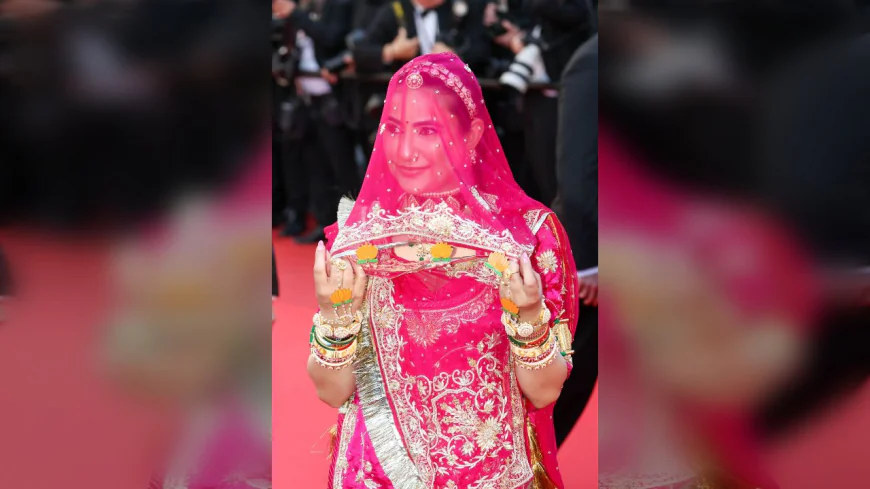
At the 79th Cannes Film Festival, Indian actress Ruchi Gujjar transformed the glamorous red carpet into a platform for meaningful social dialogue. By wearing a striking traditional Rajasthani ensemble featuring a dramatic pink ghughat-inspired veil, she drew global attention to the issue of forced ghughat practices that continue in parts of rural India.
Her appearance skillfully balanced celebration of cultural heritage with a clear call for change. While honouring the rich craftsmanship and beauty of Rajasthan, Ruchi Gujjar challenged the notion that a woman’s identity, voice, or freedom should remain hidden behind a veil of compulsion. The move quickly sparked widespread conversations across social media, fashion circles, and among international observers, marking it as one of the more socially charged Indian red carpet moments in recent years.
Speaking directly at the festival, Ruchi Gujjar articulated her intention with clarity and conviction. “I did not wear the ghughat as a symbol of silence. I wore it as a symbol of resistance,” she said. “A woman’s dignity should come from equality, confidence, and freedom — not from hiding her face. If my presence at Cannes can start even one conversation about women trapped under social pressure, then this walk had meaning beyond fashion. My Ghughat Is Not Submission. It Is A Protest.”
Coming from Rajasthan herself, the actress shared that the issue carries deep personal significance, rooted in the realities she witnessed while growing up. “Culture should empower women, not erase them. Tradition should evolve with time. Respect should never demand invisibility,” she emphasised.
The ensemble, designed by celebrated designer Roopa Sharma, featured a vibrant pink lehenga adorned with intricate silver zari embroidery, complemented by traditional jewellery and bangles. The translucent ghughat covered her face while deliberately allowing visibility — a thoughtful detail symbolising women whose identities remain visible yet often unheard in society.
Fashion observers noted how the look masterfully combined symbolism with spectacle. It stood out not just for its aesthetic appeal but for the larger conversation it initiated about distinguishing voluntary cultural expression from forced social control. Ruchi Gujjar used the moment to appeal for stronger discussions around women’s rights and empowerment, particularly in rural India. She urged leaders, policymakers, and social institutions to promote awareness, education, and freedom of choice for women in villages and smaller towns.
This appearance draws natural comparisons to other prominent figures who have leveraged the Cannes platform for advocacy. Similar to how Cate Blanchett has highlighted issues of refugees and sustainability, Emma Watson has championed gender equality, and Aishwarya Rai Bachchan has elevated Indian representation in global fashion conversations, Ruchi Gujjar chose substance alongside style.
For those following her journey, this was not her first time creating impact at Cannes. Last year, she gained significant attention for wearing a special necklace featuring Prime Minister Narendra Modi, describing it as a gesture of pride in representing India on the global stage. This year’s statement, however, carried a sharper focus on social reform, positioning her as an artist willing to initiate difficult but necessary dialogues.
The 79th Cannes Film Festival provided an ideal international stage for such messages. Ruchi Gujjar’s thoughtful approach demonstrates how the red carpet can serve purposes beyond glamour — becoming a space for cultural introspection and women’s empowerment. Her actions reflect a growing trend among Indian artists who use high-profile platforms to amplify voices from their roots and address persistent societal challenges.
As discussions continue online and beyond, Ruchi Gujjar’s Cannes appearance stands as a reminder that tradition and progress can coexist. By reclaiming the ghughat as an instrument of protest rather than submission, she has invited society to reflect on how cultural practices evolve to truly uplift women.
Her presence reinforces the power of cinema and public platforms in driving awareness. While the festival celebrates artistic excellence, moments like this highlight cinema’s role in fostering empathy and social change. Ruchi Gujjar did not simply walk the red carpet — she used it as a stage for conversation, confrontation, and meaningful progress.