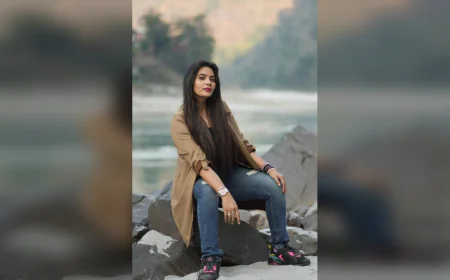
Former Bollywood actress and philanthropist Somy Ali has shared a heartfelt reflection on the life and legacy of legendary actress Parveen Babi, urging people to look beyond physical beauty and recognize the importance of mental health, compassion, and emotional well-being.
Now based in Florida, where she runs the nonprofit organization No More Tears, Somy believes Parveen’s story remains one of the most important conversations Bollywood and society continue to learn from.
“I am not here to talk about lipstick shades or red-carpet gowns. I want to talk about something far more enduring,” Somy said. “Physical beauty fades with age. What stays is how we treat the mind behind the face.”
Remembering Parveen Babi as one of Indian cinema’s most iconic personalities, Somy described her as a woman who transformed perceptions of modern Indian womanhood. Parveen’s groundbreaking appearance on the cover of TIME magazine in 1976 made her the first Indian celebrity to achieve that distinction, cementing her status as an international cultural icon.
“Parveen wasn’t just beautiful; she was revolutionary. She was bold, outspoken, and unapologetically modern,” Somy reflected. “She challenged conventions and represented a new generation of independent women.”
Beyond her glamour and public image, Somy also highlighted Parveen’s academic achievements. She noted that the actress pursued higher education in English literature, reflecting the intelligence and depth that often remained overshadowed by discussions about her beauty.
However, Somy believes the public rarely saw the emotional struggles Parveen was battling behind the spotlight.
“Behind the magazine covers and flashing cameras was a different story—one of profound psychological vulnerability,” she said. “Parveen was fighting paranoid schizophrenia at a time when mental health was rarely discussed openly.”
According to Somy, the tragedy of Parveen’s journey lies in how society and the entertainment industry often responded to her struggles.
“The same people who celebrated her beauty eventually distanced themselves when her illness became visible,” she said. “She was labelled difficult, unstable, and misunderstood instead of being offered the support she needed.”
Somy also recalled a brief encounter with Parveen during her teenage years in Mumbai, a memory that remains vivid decades later.
“I met her once in a salon when I was very young,” she shared. “Someone quietly told me not to talk to her because she wasn’t well. At that age, I didn’t understand what that meant. Today, as a trained psychotherapist and founder of No More Tears, I understand it very differently.”
Looking back, Somy admits she often wishes she had possessed the awareness she has today.
“I wish I had known then what I know now. I wish I could have offered understanding and compassion. That moment has stayed with me throughout my life.”
Somy further revealed that during her acting career, many industry professionals frequently compared her appearance to Parveen Babi’s.
“They would often say I looked strikingly similar to Parveen,” she recalled. “At that time, it felt like one of the greatest compliments a young actress could receive.”
Yet over time, she says those comparisons came to symbolize something deeper.
“It wasn’t only about beauty. It was about carrying the echo of a woman whose glamour was celebrated while her suffering remained largely unseen.”
Reflecting on how cinema has explored similar themes, Somy referenced Smita Patil’s powerful performance in the acclaimed film Arth. She praised Patil for portraying emotional vulnerability and psychological turmoil with remarkable honesty and depth.
“Smita showed audiences that mental health struggles are not signs of weakness. They are part of the human experience,” Somy said.
She also pointed to broader conversations around emotional manipulation, dependency, and psychological trauma, themes that continue to resonate in both personal relationships and public discourse today.
Ultimately, Somy believes that true beauty lies not in physical appearance but in resilience, empathy, and the courage to endure invisible battles.
“Psychological beauty—the strength to keep going despite pain—is even more profound than physical beauty,” she said.
She hopes Parveen Babi’s story encourages people to ask deeper questions about the lives behind public images.
“When we look at glamorous photographs from the past, we should also wonder what struggles existed behind those smiles,” Somy reflected.
Concluding her tribute, she emphasized the importance of compassion and understanding.
“True beauty is not the face we show the camera. It is the courage we show when the camera stops rolling. It is the empathy we offer when someone’s mind begins to fracture. That, to me, is the most timeless beauty of all.”
Through her reflection, Somy Ali not only honors Parveen Babi’s legacy but also highlights an ongoing need for greater awareness, acceptance, and support for mental health in society.