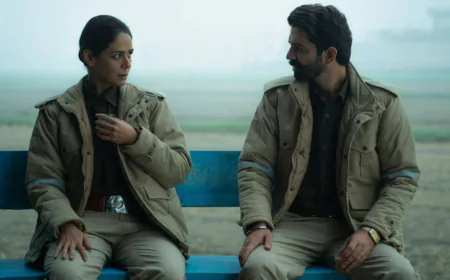
Anubhav Sinha’s Assi arrives as a gut-punch of a film, one that refuses to look away from the brutality of sexual violence while simultaneously searching for glimmers of resilience and justice in its aftermath. Clocking in at 2 hours and 14 minutes, the film opens with unrelenting dread and closes on a note few cynics would anticipate — a quiet, defiant hope that feels earned rather than imposed.
At its centre is Parima (Kani Kusruti), a Malayali schoolteacher in Delhi whose ordinary life shatters in a single night. After attending a school farewell party, she is abducted from outside a Metro station, gang-raped by five men in a moving car, and left half-naked beside railway tracks at dawn. The assault sequence is deliberately prolonged and graphic — the men’s laughter, their competitive counting, the casual cruelty — designed to trap the viewer in Parima’s terror. Sinha forces the audience to endure what she endures, a choice that has already sparked debate about the line between necessary discomfort and exploitative depiction. The brutality lingers far longer than most films dare, making the red-screen statistic that flashes later — 80 rape cases reported daily in India — feel less like information and more like a scream.
Kani Kusruti delivers a career-defining performance as Parima. Her portrayal is layered with physical pain, psychological fracture, and a slow-burning fury. When she later refuses to cover her face with a dupatta in court, declaring she is not the one who should feel shame, the moment lands with devastating clarity. Mohd Zeeshan Ayyub is equally compelling as her husband Vinay — a man who holds space for his wife’s rage and grief without ever demanding centre stage. His quiet presence, the way he calls their son “Yaara” with tenderness, and his refusal to break under pressure offer one of the film’s few anchors of humanity.
Taapsee Pannu plays Raavi, the lawyer who takes Parima’s case. Raavi believes in due process even when the system repeatedly fails, yet she is not above bending rules when justice demands it. Her grief over the hit-and-run death of colleague Kaveri (voiced by Divya Dutta) adds personal stakes to her fight, while Kumud Mishra’s portrayal of Kaveri’s secretive husband Kartik deepens the film’s exploration of guilt and accountability.
The supporting cast is uniformly strong. Manoj Pahwa plays the father of one accused, a man who weaponises influence to shield his son from consequences, while Supriya Pathak Kapur appears in a single, chilling sequence as a woman who has internalised patriarchy so completely that she now enforces it. Seema Pahwa’s school principal, disheartened by the institution’s failure to protect Parima, delivers quiet heartbreak.
Sinha and co-writer Gaurav Solanki weave multiple threads — locker-room culture, consent, social-media trials, parental accountability, and the long shadow of khap-like mindsets — into a dense narrative. A subplot involving a mysterious vigilante dubbed “The Umbrella Man,” who begins eliminating the rapists, feels narratively convenient and slightly forced, though it raises uncomfortable questions about public frustration with delayed justice.
Visually, the film maintains a muted, realistic palette that underscores the everyday nature of violence. A poignant shot of women scattering dry red chillies from a thela to carry Parima to safety nods to Ketan Mehta’s Mirch Masala, symbolising both collective shame and collective action.
Assi is not an easy watch. Its refusal to sanitise trauma will trigger many viewers, and the assault sequence’s length has already drawn criticism for potentially crossing into gratuitousness. Yet the film’s intent is clear: to confront, not entertain. By centring Parima’s agency — her decision to return to teaching, her refusal to hide, her determination to reclaim her narrative — Sinha shifts the focus from victimhood to survival and resistance.
The red-screen reminders of daily rape statistics pull the audience out of fiction and into reality, a stark reminder that the horrors on screen mirror those unfolding across the country. Whether Assi ultimately succeeds as both art and activism will depend on individual thresholds for discomfort. What is undeniable is the power of its lead performances and the courage required to tell this story without compromise.
In a landscape often accused of glossing over gender-based violence, Assi stands as a raw, unflinching document of pain — and, against all odds, a tentative step toward healing.