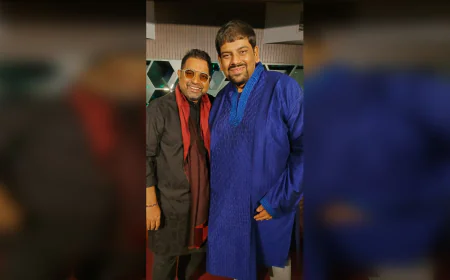
Saapna Mukerji: Remixes Can’t Replace a Song’s Soul
Singer Saapna Mukerji defends original voices against remixes, calls live shows a continuation of legacy ahead of The Oye Oye Show on March 17 at St. Andrew’s Auditorium.

Veteran playback singer Saapna Mukerji, whose voice powered some of the most enduring Bollywood tracks of the 1990s, is set to reclaim the spotlight with The Oye Oye Show on March 17 at Mumbai’s St. Andrew’s Auditorium. With more than 400 songs to her credit — including chart-toppers like “Oye Oye,” “Tirchi Topi Wale,” and “Dil Le Gayi Teri Bindiya” — Mukerji views the upcoming performance not as a nostalgic revival but as a living continuation of melodies that still resonate deeply with audiences.
In an exclusive conversation, Mukerji addressed the ongoing debate around remixes that often replace original vocals in contemporary releases. She drew a clear line between innovation and identity. “A version can never replace the original,” she stated firmly. “Its strength exists only because there is an original. They can remix the song, not its soul. When a singer has created legacy songs, that voice is part of the song’s identity.” She stressed that the emotional core of a track — forged through a singer’s unique timbre and intent — remains irreplaceable, even as production techniques evolve.
Mukerji contrasted the creative landscape of the 1990s with today’s independent music scene. Back then, playback singing was deeply intertwined with cinematic storytelling; every note had to serve the character and the film’s emotional arc. “Today, independent music isn’t bound by visuals,” she explained. “Whether it’s something celebratory, romantic or spiritual, the focus is purely on emotional intent. The shift is not from mainstream to devotional — it is from interpretation to ownership.” This evolution allows artists greater personal expression, yet Mukerji believes the timeless appeal of 90s music lies in its unfiltered humanity. “We relied on our natural voices, not technology,” she recalled. “Songs were not engineered to sound perfect — they carried a human moment. That human element is what makes them timeless. Melody outlives everything.”

The Oye Oye Show, she emphasised, is “not a comeback, it’s a continuation.” The evening promises a full live musical experience featuring her signature hits alongside heartfelt tributes to the legends who shaped Indian film music. Composer Nitin Shankar will lead his band on stage, joined by musician-singer Derrick Alexander, creating an ensemble that recreates the emotional atmosphere these songs once generated in theatres. “It’s my shraddhanjali to the voices that inspired generations,” Mukerji said, describing the performance as a shared space where melody bridges performer and listener.
She dismissed the notion that revisiting 90s tracks amounts to mere nostalgia. “When I perform these songs today, what I see is not nostalgia, I see continuity,” she asserted. “These songs are still alive because people continue to love them. They are not memories — they are living melodies.” For Mukerji, the enduring popularity across generations stems from one core quality: emotional honesty paired with strong melody. That authenticity, she believes, is what keeps audiences returning to the originals even amid a flood of remixed versions.
Live performance remains the heart of her artistic practice. “Live performance is where everything becomes real,” she reflected. “It is where the voice meets the listener. It is where the song becomes a shared experience. The stage is where music breathes.” Mukerji described singing as both a personal dialogue with the divine and a direct conversation with people. “I am simply a singer. Melody is my language. The stage feels like home. Music is my way of communicating with people and with God.”
Looking ahead, Mukerji sees her journey as one of ongoing evolution. “With every riyaaz, every song, I grow,” she said. “Music is not something I do — it is something I live every morning.” As she prepares to bring her timeless catalogue back to the stage, the March 17 concert stands as a testament to the power of original voices and the enduring strength of melody that refuses to fade. For fans who grew up with her songs and new listeners discovering them afresh, the evening promises more than hits — it offers a reminder that some melodies carry a soul that no remix can ever truly capture.