Indian Jewellery Legacy Preserved in Ancient DAAM Sculptures
Ancient sculptures preserved by DAAM reveal the timeless legacy of Indian jewellery from the 2nd century BCE to the 12th century CE. Yakshi, Harihara, Shiva-Parvati and Vaishnavi figures showcase intricate designs that continue to inspire modern fashion and cultural identity.

Mumbai, March 2026: Indian jewellery has never been just about adornment. For thousands of years, it has served as a profound symbol of identity, spirituality, social status, and cultural expression. A remarkable collection of ancient sculptures preserved by DAAM (Digital Archive of Ancient Monuments) brings this timeless legacy to life, offering a vivid journey from antiquity to its continued influence on contemporary fashion and design.
These stone masterpieces do more than showcase artistic brilliance — they act as historical documents, revealing the aesthetic sensibilities, societal structures, and everyday lives of people across different eras. From delicate pearl strands to elaborate crowns and symbolic ornaments, the jewellery carved into these figures tells stories that resonate even today.
One of the earliest and most sophisticated examples dates back to the 2nd century BCE during the Shunga period. The Yakshi sculpture from Bharhut depicts a graceful female figure standing within a blossoming lotus. She is adorned with intricate five-strand pearl necklaces, elaborate earrings, and layered garlands. Holding a lotus in her hands, with a gentle smile and carefully styled hair, the Yakshi reflects the refined artistic and cultural importance of jewellery in early Indian society.
Moving forward to the 9th–10th century CE, the Harihara sculpture presents a powerful representation of the fusion of two major Hindu deities — Shiva and Vishnu — in a single form. The duality is masterfully expressed through contrasting headgear: matted locks symbolising Shiva on one side and an ornate crown for Vishnu on the other. Jewellery further distinguishes the aspects — serpent-shaped earrings for Shiva and sun-disc earrings for Vishnu — along with armlets, necklaces, sacred thread, and waist adornments. The presence of their respective mounts, Nandi the bull and Garuda the eagle, adds deeper symbolic meaning to this remarkable composition.
An 11th-century sculpture from the Paramara period narrates the dramatic mythological episode of Ravana attempting to lift Mount Kailash. Shiva and Parvati are shown seated gracefully on Nandi and a lion respectively. The detailed ornamentation includes circular earrings, pearl necklaces, layered chains, armlets, and floral garlands on Shiva, while Parvati wears cascading necklaces, earrings, and intricate chest ornaments. The scene comes alive with accompanying figures of Ganesha, Kartikeya, Brahma, Vishnu, and Gandharvas, making it both a narrative and decorative masterpiece.
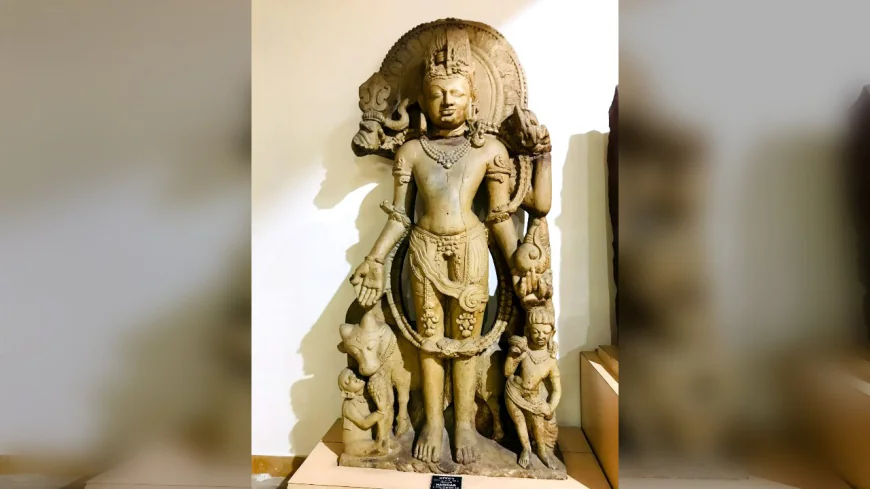
The Vaishnavi sculpture from the 11th–12th century stands as a fine example of regional stylistic influences. Depicted in a standing posture, the goddess holds her traditional attributes — conch, discus, mace, and lotus. She is richly adorned with a crown, earrings, layered necklaces, waist girdle, Vaijayanti garland, anklets, bangles, and armlets. At the base, a devotee figure is shown receiving her blessings, adding a touching devotional element to the sculpture. This piece clearly illustrates how jewellery was deeply integrated into divine iconography and religious expression.
Dr. Manisha Sharma, Joint Director at DAAM, aptly summarised the significance of these works: “These sculptures reaffirm that Indian jewellery is far more than decoration; it is a living document of time, society, and human emotion. Every ornament carved in stone carries within it the aesthetic values and cultural narratives of its era.”
The heritage preserved by DAAM offers a unique window into how Indian jewellery traditions have evolved over centuries without losing their core essence. Designs that originated in ancient times continue to inspire modern jewellery makers, fashion designers, and cultural enthusiasts. What we see in contemporary Indian adornment is not isolated innovation but a beautiful continuation — an unbroken dialogue between the past and the present.
Through these meticulously preserved sculptures, DAAM is helping bridge ancient craftsmanship with today’s artistic expressions. They remind us that Indian jewellery is not merely an accessory but a powerful thread that connects generations, reflecting continuity, creativity, and cultural pride across time.
As interest in heritage revival grows, collections like those at DAAM serve as an invaluable resource for scholars, artists, and anyone seeking to understand the deep roots of India’s rich jewellery tradition.